
Customer cases
A leading Chinese smart-technology group: sports and health laboratory
The source describes an unnamed group known for smartphones and AIoT, with a sports and health laboratory that validates algorithms for bands, watches and physiological monitoring devices serving a very large user base.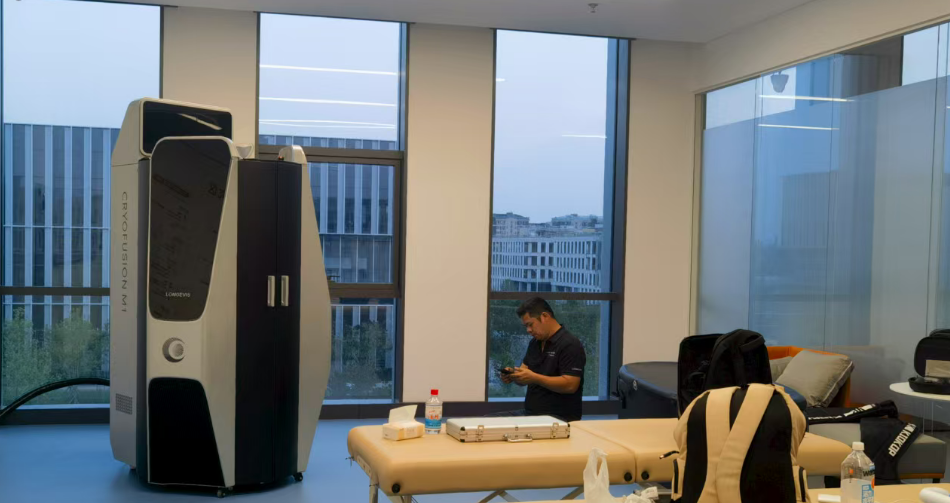
Cold-exposure infrastructure for sports and health research
The source describes an unnamed global smart-technology company with long-standing work in wearable devices, sports and health algorithms, and human physiological data. It presents the company’s internal sports and health laboratory as a prominent research setting built around professional methods, data and technical validation.
After evaluating several recovery technologies, the laboratory selected a LONGEVIS ultra-low-temperature chamber as part of its core recovery equipment. The source lists the intended uses as:
- Observing changes in physiological parameters after intensive exercise.
- Studying the effect of cold exposure on heart-rate variability (HRV).
- Analysing metabolic and circulatory responses to temperature stimuli.
- Adapting and validating wearable-device data in cold-exposure scenarios.
Why the source says it chose LONGEVIS CryoFusion Technology
The laboratory sought controllable, repeatable and quantifiable cold-exposure infrastructure to support algorithm development and human testing. The article attributes the following capabilities to LONGEVIS:
- A stable, calibratable temperature curve for research use.
- Redundant safety mechanisms described as meeting the laboratory’s human-testing requirements.
- Data visualization and interface expansion for integration with experimental systems.
- Low resource consumption and continuous operation for frequent experiments.
Research applications reported by the source
The article says the chamber has been used in several internal investigations, including:
- HRV and autonomic-response patterns before and after cold exposure.
- Effects of cold exposure on skin-temperature distribution and energy metabolism.
- Joint validation of use-case algorithms with smart bands and watches.
- Comparisons of different approaches to recovery after exercise.
The source states that the findings are intended to inform the company’s health algorithms and more evidence-informed exercise-recovery guidance for its users. It does not name the company or provide published results in this case.
